
Multi-Site IT Infrastructure Modernization and High-Availability Network Design
Organizations operating across multiple locations require more than traditional IT support. They need highly available infrastructure, redundant connectivity, disaster recovery capabilities, secure remote access, and scalable technology platforms that support business growth without interruption.
This case study highlights a comprehensive multi-site IT infrastructure modernization project involving network redesign, virtualization, storage replication, VoIP migration, cybersecurity improvements, and business continuity enhancements across multiple geographically distributed offices.
Meeting the Demands of a Multi-Site, High-Availability Environment
Supporting a business with multiple locations across different states presents unique IT challenges. These organizations require extreme uptime, robust storage and replication, multi-path ISP failover, and fully redundant infrastructure to maintain seamless operations. We collaborated with the client to design and implement an IT infrastructure tailored to their operational needs, enhancing high availability, security, and efficiency. This project involved a significant investment, reflecting the scale and complexity of the implementation.
Building a Resilient Network Architecture

Reliable Connectivity
To achieve this, we developed a sophisticated network topology featuring:
- Multi-Path ISP Failover: Each office had multiple ISP connections with independent WAN switches, enabling bandwidth control and failover capabilities.
- Redundant Firewall Configuration: Active-passive failover firewalls at each location provided security and continuity during outages.
- Layered Switching Architecture
- VOIP network supported by a dedicated 7-switch stack for optimized voice performance.
- Core switching managed through a 2-switch stack, interconnecting all other stacks.
- WAN traffic controlled via a Core WAN switch stack consisting of a 2-switch stack, with each ISP connected to both switches to provide multiple failover paths, improving redundancy and high availability. The main office utilized dedicated fiber internet with an additional ISP for redundancy, while each remote office had independent ISP connections. This setup provided resilient routing between sites, ensuring that if a remote office's internet connection failed, traffic could seamlessly fail over to the main office through the EVPL fiber. Additionally, intelligent traffic routing and path selection optimized performance across the entire network.
- Data switch stack with 8 high-speed 10Gbps switches, ensuring optimized data throughput across all critical infrastructure with redundant paths to the core network.
- Complete IP Scheme Overhaul & VLAN Segmentation for Security & Performance: A complete overhaul of the IP scheme was conducted to eliminate legacy addressing conflicts, improve subnet efficiency, and optimize traffic flows. VLANs were implemented to segment critical business functions, reducing security risks and enhancing network performance by limiting unnecessary traffic and improving policy enforcement.
- Multiple Path Redundancy with LAGG: Every switch stack had redundant paths to the 10Gbps core for fault tolerance and performance optimization.
- Redundant Wireless Access Points: High-density, seamless Wi-Fi coverage with automatic failover at all locations, allowing devices to move between offices without requiring network or configuration changes.
- Interoffice Connectivity & Failover: Each office was connected using IPSEC over EVPL fiber as the primary connection, enabling secure and high-speed communication between locations. Additional IPSEC tunnels to the main location provided alternative paths in case of primary link failure. The main office had fiber internet, while each remote office maintained independent ISP access. In case of an ISP failure at a remote site, network and internet traffic could fail over to the main office over the EVPL fiber connection. If the main site experienced an outage, remote offices could revert independently. To support this level of failover and dynamic routing, we deployed advanced routing protocols and custom routing rules that adjusted traffic flows in real time, ensuring optimal performance and minimizing downtime.
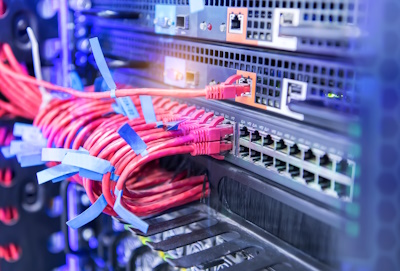
Enterprise-Grade Virtualization & Storage Redundancy
To support mission-critical applications and services, we implemented:
- Multi-Node Hyper-V Clusters: Each site maintained a fully redundant cluster to avoid single points of failure.
- Synchronized Storage Replication: Data replication between sites maintained operational continuity.
- Backup & Recovery Solution: A comprehensive backup strategy protected key systems from data loss and cyber threats.
Modernizing the IT Infrastructure
- Active Directory Redesign & Group Policy Implementation: A full Active Directory (AD) restructuring eliminated legacy configurations, improved security, and streamlined device management. Group Policy (GPO) implementation enforced security baselines and standardized IT policies across locations.
- Hybrid Cloud Integration: On-premise infrastructure was strategically combined with cloud technologies to balance performance, scalability, and security.
- Eliminating Legacy Network Risks: Instead of migrating an outdated 40-year-old network, a complete rebuild was performed to establish a reliable, modern IT foundation, reducing inherited security and performance issues.
VoIP Migration: From Legacy PBX to Modern SIP Trunks

A major part of this transformation was replacing a 25-year-old PBX system with a modern VoIP solution, leading to approximately $6,000 in monthly cost savings by eliminating outdated T1 trunk expenses and transitioning to SIP trunks. Additionally, this significantly reduced ongoing PBX vendor support costs, which had become an operational burden.
This upgrade:
- Provided advanced call routing, voicemail-to-email, and unified communications.
- Improved reliability with redundant voice infrastructure.
- Integrated with business applications for streamlined workflows.
- Reduced long-term operational costs while improving scalability.
- Ported over 400 numbers from legacy T1 trunks to modern SIP trunks, facilitating a smooth transition while maintaining business continuity.
- Implemented multiple failover paths to ensure uninterrupted call routing in case of network or provider disruptions.
Enterprise Application Migration & Vendor Coordination
As part of the rebuild, we coordinated the migration of two critical business applications:
- Accounting & Time Tracking System: Designed and deployed a modernized version in collaboration with the software vendor.
- Document Management System: Ensured data integrity while transitioning to a new, more secure and efficient platform.
Secure Remote Access & File Sharing
With a distributed workforce, secure remote access was a necessity. We implemented:
- Secure Gateway for Remote Staff: Enabling controlled, encrypted access to internal resources.
- Enterprise File Sharing Application: Used for secure file exchange with clients, reducing reliance on third-party services and improving data control.
Advanced Teleconference Solutions & Mobile Conferencing

To support enterprise-wide communication, we implemented an advanced large-scale teleconference solution that integrates seamlessly with both on-premise and cloud-based collaboration tools.
- High-Definition Video & Audio Conferencing: Providing seamless cross-location communication.
- Large Conference Room Integration: Enterprise conferencing systems deployed within key meeting locations for executive meetings, employee collaboration, customer presentations, and training sessionsram Development: A structured security framework was implemented using industry-recognized cybersecurity best practices and organizational security requirements.
- Risk-Based Security Measures: Integrated security controls, access restrictions, and incident response protocols.
- Continuous Security Monitoring: Ongoing assessments and policy refinements to adapt to evolving cybersecurity threats.
Managing Complexity: Vendors, Security, and Patch Management
With a complex infrastructure and multiple service providers, ongoing management remained a priority:
- Vendor Coordination: Managing relationships with ISPs, security providers, and technology vendors.
- Security & Compliance Oversight: Layered security solutions minimized vulnerabilities.
- Proactive Patching & Updates: Ensuring all systems remained secure without disrupting operations.
- Network & System Monitoring: Continuous performance evaluation and issue resolution.
Business Results and Outcomes
- Eliminated multiple infrastructure single points of failure.
- Improved business continuity across all locations.
- Established resilient multi-site failover capabilities.
- Enhanced network performance and operational efficiency.
- Improved disaster recovery readiness through storage replication and backup solutions.
- Reduced telecommunications expenses by approximately $72,000 annually.
- Modernized a decades-old technology environment.
- Created a scalable foundation capable of supporting future growth.
Conclusion
This IT modernization effort successfully established a scalable, resilient, and secure multi-site infrastructure. By leveraging redundant networking, hybrid cloud integration, VoIP transformation, advanced collaboration technologies, and enhanced security controls, the client achieved improved efficiency, reduced costs, and long-term sustainability.
The result is a modern technology foundation capable of supporting future growth, improving business continuity, strengthening cybersecurity, and delivering long-term operational value across all locations.
Planning a Multi-Site IT Infrastructure Upgrade?
Whether your organization operates across multiple offices, requires high-availability infrastructure, or is planning a network modernization initiative, our team can help design and implement secure, scalable, and resilient technology solutions.
Contact Us Today to discuss your infrastructure modernization goals.